

News Details
Climbing skills for manual forklifts
When we use a manual forklift to pull a fully loaded pallet uphill, we often encounter two tricky situations: one is that the goods have a tendency to tilt backwards due to the high center of gravity, which is perpendicular to the ground; Secondly, there is insufficient friction between the goods and the forks, causing the pallet to slowly slide down the slope. No matter what happens, it will lead to a deadlock in the handling work.
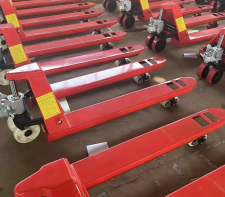
We can adopt completely different response strategies for these two situations.
If it is the first case, the goods are significantly high and the center of gravity is unstable. If the goods are not overweight, there is no need to deliberately reduce the load for climbing, which will actually reduce work efficiency. The safest way is to call a colleague from behind to help push and stabilize the center of gravity of the goods with external force, and then safely pass through the ramp. If only one person is operating, then consider reducing the weight of the goods.
If it is the second case, the pallet did not tip over, but gradually slipped off the fork along the slope direction, which indicates that there are not many goods themselves, and the problem mainly lies in insufficient friction. The solution is also very simple: just change "pulling uphill" to "pushing uphill". Because during the implementation, even if the pallet still has a downward trend, the pouring type oil cylinder and arm of the manual forklift will act as a barrier to hold the pallet, preventing it from detaching from the fork and firmly fixing it in place.
It can be seen that identifying the root cause of the same problem can lead to targeted treatment. A light push and a change of direction are often more effective than brute force or blindly reducing the burden. Mastering these skills can not only ensure safety, but also make the handling work more efficient.