

News Details
Analysis and Maintenance of Hydraulic Cylinder Lifting Fault in Manual Hydraulic Transporter
Manual hydraulic handling vehicles are commonly used handling tools in warehousing and logistics, and oil cylinders, as their core hydraulic components, directly control the lifting and lowering of goods. Once the oil cylinder malfunctions, the fork cannot lift and lower normally, seriously affecting work efficiency. For the problem of the fork frame not being able to descend or ascend, the reasons can usually be investigated from the following three aspects.
1、 Overloading or overloading can cause mechanical damage. When the weight of the goods exceeds the rated load of the handling vehicle, or when the center of gravity of the goods deviates from the center of the fork, the piston rod and oil cylinder will bear additional lateral force and bending stress. In the long run, the piston rod is prone to bending and deformation, and the inner wall of the oil cylinder may also be pulled, resulting in the obstruction of piston movement. At this time, the piston rod or oil cylinder should be replaced according to the degree of damage, and it should not be forced to be used to avoid the expansion of the fault.
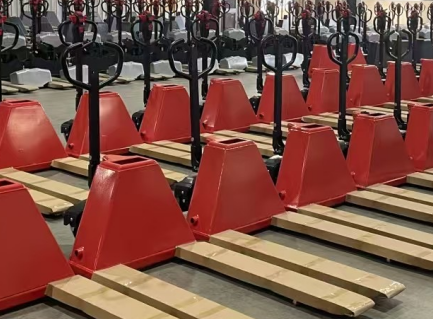
2、 Corrosion of the piston rod hinders movement. The piston rod is exposed to the outside for a long time, and if the environment is humid or lacks maintenance, the surface is prone to rusting. The rust layer will increase the frictional resistance between the piston rod and the seal, causing the piston to move poorly or even get stuck. After daily use, the piston rod should be wiped and rust proof oil should be applied in a timely manner; If the corrosion is severe, the piston rod needs to be replaced.
3、 Improper adjustment of nut position. If the adjustment nut and hex nut on the oil cylinder are not in the correct position, it will affect the normal oil return and pressure relief of the hydraulic system, causing the fork to be unable to descend or ascend weakly. At this point, the nut should be readjusted to the specified position. It is worth noting that when not using a transport vehicle, it is necessary to lower the vehicle to the lowest position and fully retract the piston rod into the oil cylinder to avoid long-term exposure; Regularly inspect and readjust the nuts to ensure they are in the correct condition.
In short, cylinder failures are often caused by overloading, corrosion, and nut misalignment. In daily use, overloading and uneven loading should be strictly avoided, the piston rod should be kept clean and rust proof, the frame should be lowered when parking, and the nuts should be checked and adjusted regularly. Only by doing preventive maintenance can the service life of the oil cylinder be extended and the safe and efficient operation of the transport vehicle be guaranteed.